
Table of Contents
Introduction
Some of my very favorite feedback I ever get from teachers sounds like this: “I loved hearing the conversations my students were having while they worked on math.” That’s the good stuff. That’s the moment you know learning is actually happening, not just answer-getting.
If you’ve been following along, you know we’ve already talked about communication strategies with students and communication strategies with parents. Today we’re tackling the third piece, and honestly one of my favorites: student-to-student communication. Specifically, students having real conversations to work through problems together. Several of the activities I create make these conversations happen naturally and easily, and I’ll share three of them below. But first, let’s talk about why all this chatter matters so much.
The Social-Emotional Side of Math Talk
Here’s the thing about getting students to talk to each other about math: it’s not just “nice.” It’s backed by a whole lot of research, and it builds skills that go way beyond the math itself.
The National Council of Teachers of Mathematics names facilitating meaningful mathematical discourse as one of its eight core teaching practices in Principles to Actions (2014), calling discourse “central to meaningful learning of mathematics.” When students explain their thinking out loud and respond to a classmate’s reasoning, they reinforce what they know and bump up against the gaps they didn’t realize were there. Saying it out loud is where the understanding gets real.
And it’s not only an academic win. The Collaborative for Academic, Social, and Emotional Learning (CASEL) lists relationship skills — communicating clearly, listening well, cooperating, and seeking and offering help — as one of its five core competencies. A math conversation is basically a relationship-skills workout in disguise. When two students compare answers and one says “wait, how did you get that?”, they’re practicing exactly those skills.
A few of the benefits researchers and teachers see when students talk math with each other:
- Deeper understanding. Explaining your reasoning forces you to organize it, and listening to a different approach stretches how you see the problem.
- Productive struggle feels safe. Kids get comfortable wrestling with a hard problem — and even making mistakes — when they know a conversation, not a red pen, comes next.
- Stronger math identity. Positive peer interactions make students more willing to take intellectual risks, ask questions, and admit when they’re confused.
- Real-world skills. Communicating, collaborating, and working through disagreement respectfully are life skills, not just math-class skills.
- Less pressure on you. When students become each other’s first line of help, you’re freed up to circulate, listen in, and support the kids who need you most.
In other words, when we plan for student-to-student talk, we’re teaching math and growing kinder, more confident, more capable humans. Not a bad deal.
My Favorite Activities That Spark These Conversations
These three are the ones teachers leave feedback specifically because of the talk they create. The best part? The conversation is built right into the design — you don’t have to force it.
1. Self-Checking Activities
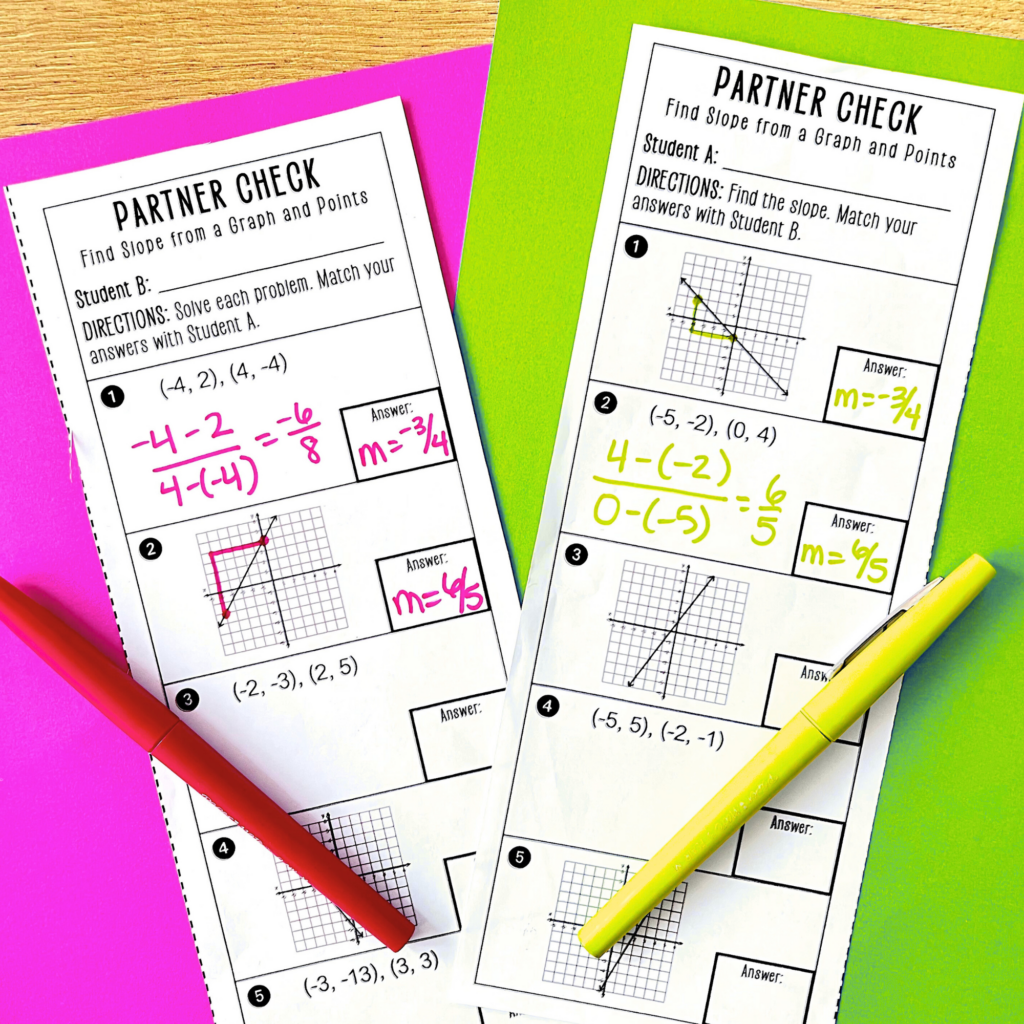
This is my classic. Each activity comes in three versions — Self-Check, Partner Check, and Triple Check — where students solve different problems but should land on the same answers. When their answers match, high five. When they don’t match? That’s the magic. Now they have to talk it out, retrace their steps, and hunt down the mistake together. Built-in error analysis with zero prep from you. Learn more about these activities in this blog post: Self-Checking Math Activities
Available for 4th grade–Precalculus across many topics. Browse the Self-Checking activities here.
What teachers say:
“Easy to use for students and teacher! Self checking leads to great conversations when answers don’t match. Well made resources that I can always count on…I love all of these activities and the topics are amazing! I’ve used the partner and triple versions (great for small groups.) Lots of good discussion when answers don’t match!” – E G.
“I love the conversations that arose when students were doing this. I loved they were talking about math, they loved that it didn’t have a lot of questions.” – Math with Miss Fracch
“This is my absolute favorite resource I’ve used so far this year!! My students were so engaged. We started by using the Self Check as a class, then moved to Partner Check, and last Triple Check. I watched as their confidence increased with each question they got correct, and I heard lots of math talk as they found the mistakes that were keeping them from having matching answers.” – Sarah S.
“The students liked having the immediate feedback of whether the questions were correct by comparing answers with their classmates. Differences in answers led to very productive discussions and error analysis. I like that this activity includes a good variety while keeping it short enough for a quick check of understanding.” – Ashley L.
“My students love anything that is self-checking. The fact that I could group students to work together in pairs/3s made this even better – great to see them helping each other and using mathematical discussion.” – Sarah V.
2. Name That Function Activities
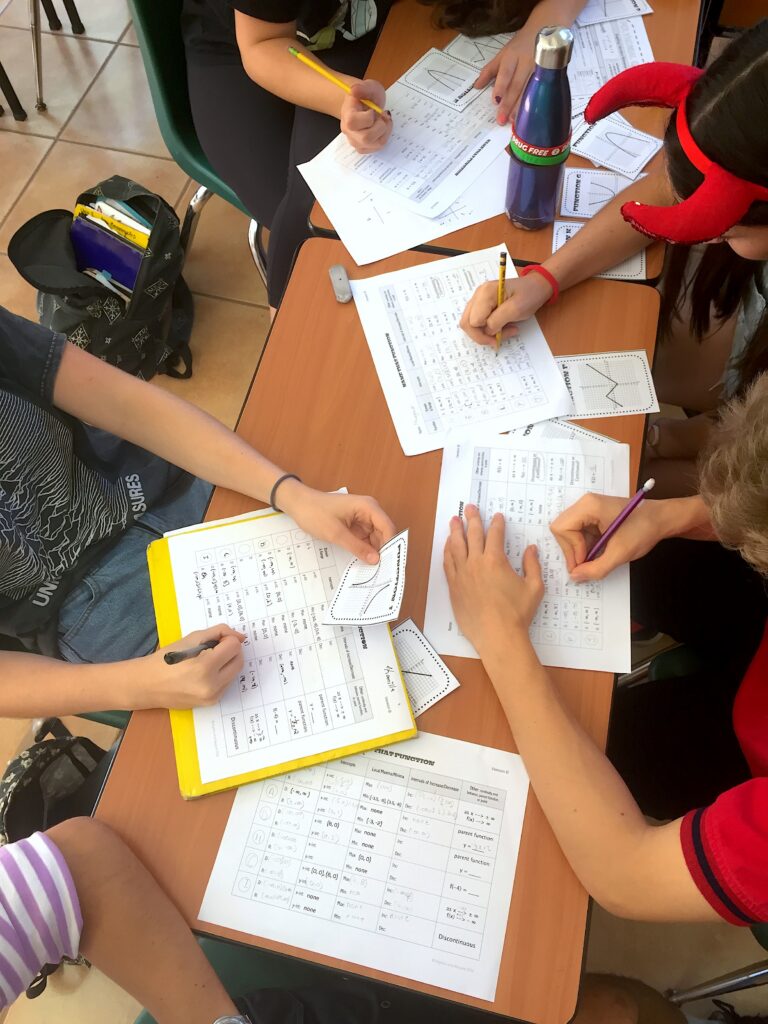
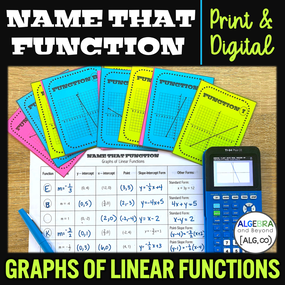
These get students matching graphs to their features, equations, and characteristics — and there is just enough room for interpretation that students naturally start debating. “I think that one’s even.” “No wait, look at the end behavior.” That back-and-forth is students reasoning through function families together, and it sticks so much better than me telling them. Learn more about these activities in this blog post: Analyzing Graphs
Great for 8th grade – Precalculus. See the Name That Function activities here.
What teachers say:
“My students worked on this in small groups as a review activity. They were engaged with it during class and had some great discussions while deciding which graph was the correct one and completing the missing information. I think it really helped some of them “put it all together”.” – Carol R.
“Great activity – my kids were able to apply their understanding and had great math conversations while they were working together.” – Heather K.
“Loved this activity! Used it multiply times and kept students very engaged. We had the students were with partners and they actively discussed the graphs and features between each other.” – Elaine P.
“I used this in my Algebra 1 class after a short introduction. The students eagerly got started and were able to draw conclusions on their own. We saved time at the end of the class for groups to share out what the noticed/wondered and we had some great discussions. Thank you!” – Lori O.
3. iStep Activities
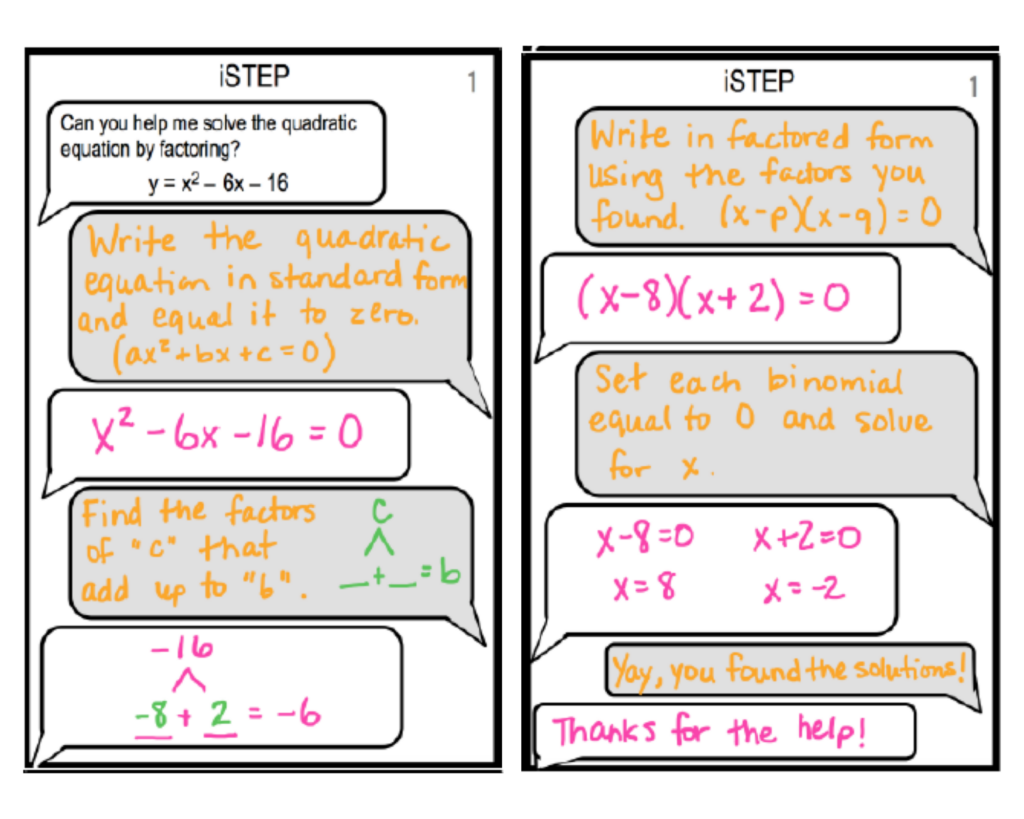
These are a fun twist: students work through a problem in a “texting” style format, explaining each step in words as they go — almost like they’re messaging a friend to walk them through it. They have to justify their thinking and put the math into language, which is exactly the kind of communication that reveals whether they really get it. Kids love the format, and you get a window straight into their reasoning. Learn more about these activities in this blot post: Messaging in Math
Available for 7th-10th grade, digital and ready to assign. Check out the iStep activities here.
What teachers say:
“Fantastic way to get students communicating about math and reinforcing the steps of solving different types of equations.” – Pam T.
“This makes for great evidence of thinking and accountable talk. It forces you work with peers in a unique way. I will buy more sets.” – Cari F.
“Great resource to use with my algebra students! Set up in a unique and engaging way to check student understanding, as it has them explain their answers mathematically and in words.” – Kayla R.
“I’ve been wanting to try this because it helps students feel as though they are discussing with their friends in real life. Also, succinctly answering questions helps me easily identify whether students truly understand a topic.” – Erika R.
The Takeaway
You don’t have to choose between rigorous math and a warm, connected classroom — student-to-student communication gives you both. The conversations build understanding, the relationships build confidence, and you get to step back and listen to your students teach each other. That’s a pretty wonderful sound!




No comments yet.